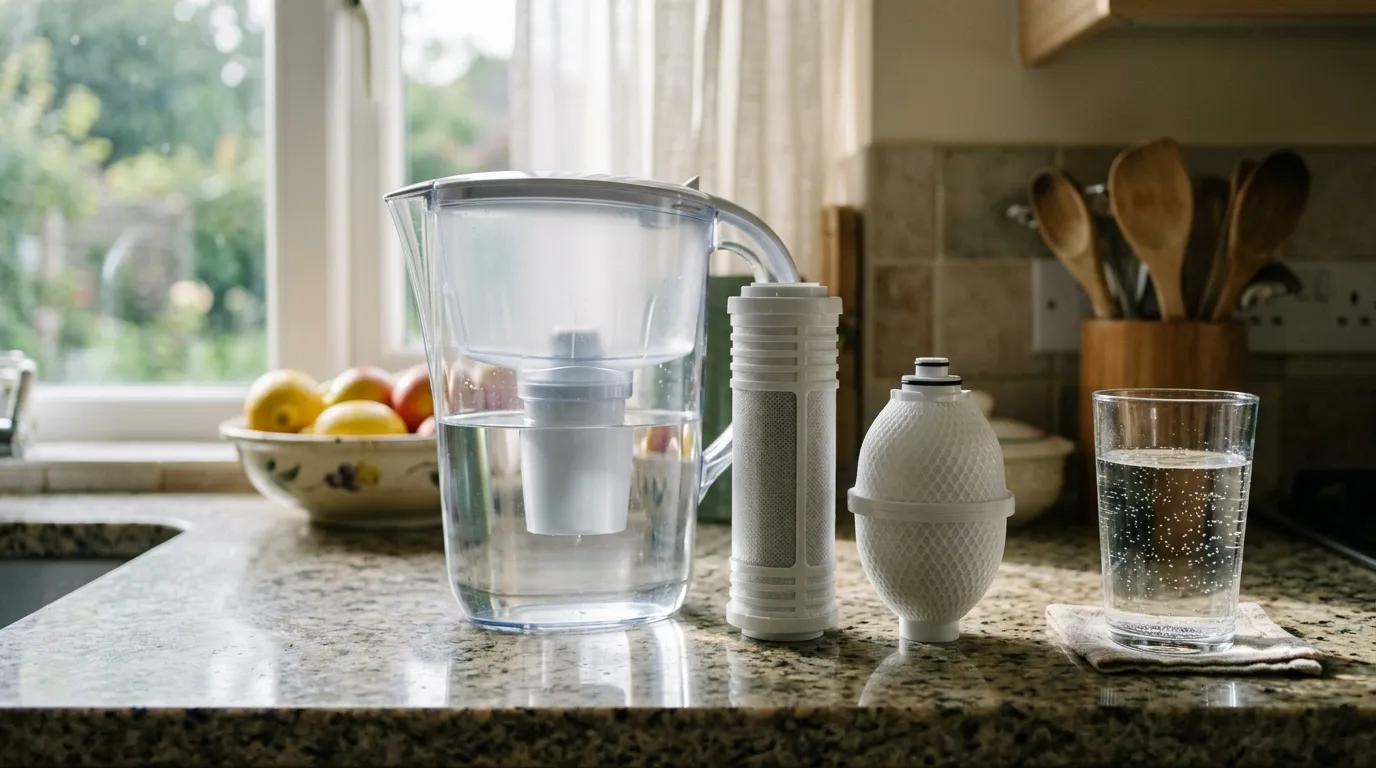
Best Water Filter Pitcher for PFAS and Lead: What to Check First
Pitcher and cartridge certifications for PFAS and lead across Brita, ZeroWater, Clearly Filtered, PUR, and LifeStraw, checked in the NSF and WQA databases September 24, 2026, with rated gallons and cost per gallon.
Final Decision
Quick answer: Checked in the NSF and WQA databases on September 24, 2026: Brita's Elite/Longlast+ cartridge (used in the Denali and Pacifica pitchers) is NSF-certified to Standard 53 for lead. ZeroWater's 5-Stage cartridge is IAPMO-certified for lead, PFOA/PFOS, chlorine, chromium and mercury, per ZeroWater's own certification page. PUR's PLUS cartridge (PPF951K) was newly certified by IAPMO R&T on September 15, 2026 to reduce lead, microplastics and Total PFAS, a claim not yet visible in NSF's own public database. LifeStraw's Home pitcher carries manufacturer-stated NSF 42/53/401 and EPA/NSF P231 claims that a direct search of NSF's public database could not confirm this run. Clearly Filtered's pitcher, despite marketing that names 365-plus contaminants, currently carries only a WQA listing for NSF/ANSI 372, a lead-free construction standard, not a lead or PFAS reduction claim; the company's own help center states its 53 and 401 certifications are still pending.
Best for
Renters, students, apartment households, and low-install buyers comparing pitchers and dispensers who want the exact cartridge's certification checked against a database, not the box copy.
Wrong fit
Homes with nitrate, arsenic, bacteria, or high-volume drinking-water needs.
Tradeoff
A pitcher's marketing page and its live independent certification are not always the same list, and the gap between the two can be the difference between a verified lead or PFAS claim and an unverified one.
Pitchers are convenient, not magic
A pitcher can be the right answer when installation is not realistic. It can also be a bad answer if the contaminant needs a different technology or if the household drinks enough water to overwhelm a small cartridge.
This page used to compare pitchers on PFAS and lead alone. It now compares the exact cartridge behind five popular pitcher lines on certifying body, standard number, rated capacity, and cost per gallon, because those are the numbers that separate a verified claim from a marketing claim. For PFAS and lead specifically, the exact cartridge model matters more than the brand name on the pitcher.
What to check before buying
Does the exact cartridge model claim PFAS reduction, lead reduction, or both?
Is that claim independently certified (NSF, WQA, or IAPMO), or is it a manufacturer performance-data claim with no listing to check?
How many gallons is the cartridge rated for, and does the printed replacement interval match how much your household actually drinks and cooks with?
How much does replacement cost per year, and per gallon?
How slow is the flow when the cartridge is near the end of life?
If a product page is vague about the standard number, verify it directly in the certifier's database before assuming the claim covers your contaminant.
Model-level certification and cost, checked September 24, 2026
IAPMO, per ZeroWater's own certification page; no standard number published there; not found in NSF's public database under this trade name
Lead, PFOA/PFOS, chlorine, chromium, mercury
approx. 40 gal typical, but ZeroWater's own guidance is meter-driven (replace at a TDS-meter reading of 006 or higher), so real life ranges roughly 8-40+ gal by source water
$19.99 single; approx. $15 each in a 6-pack ($89.99)
WQA Gold Seal lists only Standard 372 today; company states 42/372 are mid-transfer to NSF and 53/401 are still being pursued, not yet obtained
Lead-free construction only (372). No live lead or PFAS reduction certification
100 gal / 6 mo label (mfr. suggests 2-3 mo for 3+ people)
$58.50 (list $65)
$0.59
PUR PLUS 11-Cup pitcher PPT110WA ($34.99) + PPF951K cartridge
IAPMO R&T, certified September 15, 2026, to NSF/ANSI 42, 53, 401 (per PUR's own release; not yet in NSF's public database)
Lead (99.9%), microplastics (99.8%), Total PFAS (99.75%), all manufacturer-stated
40 gal / 2 mo label
approx. $12.96 (retailer-listed; pur.com's own price renders through client-side scripts)
approx. $0.32
LifeStraw Home 7-Cup pitcher ($64.95): carbon+ion-exchange filter and membrane microfilter
Manufacturer states NSF 42/53/401 plus EPA/NSF P231; a direct NSF database search under "LifeStraw" and "LifeStraw Home" returned no matching listing this run
Bacteria/parasites (P231), lead/PFOA-PFOS/VOCs (53), microplastics (401), chlorine (42), all manufacturer-stated
Carbon+IX: 40 gal / 2 mo. Membrane: 264 gal / 12 mo
Prices and certification-database results checked September 24, 2026. Where a manufacturer's own site would not render a price through a direct fetch (PUR, LifeStraw's membrane filter), a named retailer listing is used instead and flagged as lower confidence, the same convention this site uses on its five-year cost guide.
What the database check actually found
Brita's naming is not what you'd search for. The lead-certified NSF/ANSI 53 listing does not appear under the trade name "Brita" or "Elite." It is filed under "Pacifica," the pitcher's own model name, covering the OB41 pitcher and OB06 filter combination. Searching by brand name alone in NSF's database would have missed it.
PUR's certification is nine days old. PUR's September 15, 2026 announcement that its PLUS cartridge is now certified to reduce lead, microplastics, and Total PFAS is a real, dated, named-standard claim from the manufacturer, but it had not yet propagated to NSF's own public listing search as of this run. IAPMO R&T's own product directory is a JavaScript-rendered tool that could not be queried directly this run, so this claim carries a manufacturer-published source, not yet an independently re-verified database listing.
Clearly Filtered's marketing outruns its live certification. The brand's own site markets reduction of "365-plus contaminants," but the only certification currently active in WQA's Gold Seal directory for the pitcher is NSF/ANSI 372, which covers lead-free construction material, not a reduction performance claim. Clearly Filtered's own help center (checked the same day) confirms this directly: NSF/ANSI 42 and 372 are mid-transfer from WQA to NSF, and NSF/ANSI 53 (lead) and 401 (emerging compounds) are still being pursued, not held today.
ZeroWater and LifeStraw name standards that a direct NSF search could not confirm. ZeroWater's own page states IAPMO certification without a standard number, and it does not appear in NSF's database, consistent with IAPMO and NSF keeping separate registries. LifeStraw's own product page names NSF 42, 53, 401 and the P231 protocol, but a direct search of NSF's public listing tool under "LifeStraw" and "LifeStraw Home" returned no matching product this run. Neither absence proves the claim is false. It means the claim rests on the manufacturer's own statement rather than a same-day independent listing this run could locate.
What each pitcher is not certified for
Pitcher
Not certified for, despite the marketing
Brita Denali + Elite
PFAS/PFOA/PFOS. No such claim appears on Brita's own lead-reduction page or in the NSF or WQA listings checked for this cartridge.
ZeroWater 5-Stage
Fluoride and nitrate reduction are described as filtration performance on ZeroWater's own site, but neither appears in the list of contaminants its stated IAPMO certification covers (lead, PFOA/PFOS, chlorine, chromium, mercury).
Clearly Filtered pitcher
Lead reduction and PFOA/PFOS reduction. Despite broad contaminant marketing, the pitcher's only currently active WQA listing is the lead-free-construction standard 372, not a performance certification for either contaminant.
PUR PLUS PPT110WA
Nothing beyond its stated list was found missing, but the lead/PFAS/microplastics certification is nine days old as of this update and has not yet appeared in NSF's own public database.
LifeStraw Home 7-Cup
Fluoride, nitrate, nitrite, and phosphate reduction, explicitly disclosed as not removed on LifeStraw's own product page.
Search method. In NSF, by trade name (brand, model, and, where the brand name returned nothing, the pitcher's own product name) and by standard number. In WQA, by manufacturer name, which surfaced the exact listing detail pages cited above.
What this did not check. Flow rate near end of cartridge life, which none of the five manufacturers publish as a specific number, and the household-size correction to rated capacity. The five-year cost guide's capacity-math section covers how a family of four can burn through a 120-gallon cartridge in about a month instead of six.
Brands to compare
Clearly Filtered is the broad-claim pitcher on paper, but check the certification table above before paying its premium price: today, only its lead-free-construction claim is independently certified. ZeroWater suits buyers who want a visible TDS meter and are comfortable replacing filters on a meter reading rather than a calendar date; filters can be consumed quickly in high-TDS water. Brita is the mainstream value brand, but its lead-reduction certification belongs to the Elite/Longlast+ cartridge specifically, not every Brita filter. PUR is also relevant for faucet-mounted filters, and its pitcher cartridge just picked up a broader certification than it carried a month ago. LifeStraw is the two-filter design of the group, worth comparing when bacteria and parasite reduction are part of the purchase story alongside chemical contaminants.
When a pitcher is the wrong answer
Do not rely on a pitcher as the only answer for:
Private-well bacteria concerns.
Boil-water notices.
Nitrate above a health limit.
Arsenic concerns without a matching claim.
Whole-home sediment, scale, or shower issues.
A large household that needs many gallons per day.
Frequently Asked Questions
Is Clearly Filtered better than Brita?
Not on live certification, as of this check. Brita's Elite/Longlast+ cartridge carries an NSF/ANSI 53 lead-reduction certification you can verify today. Clearly Filtered's pitcher carries only a lead-free-construction certification (372) right now, with its lead and PFAS reduction certifications still pending by the company's own account. Clearly Filtered may still be the stronger long-term choice once those certifications land, but "365-plus contaminants" on the box is not the same claim as a certified reduction number today.
Is ZeroWater reverse osmosis?
No. ZeroWater uses a multi-stage ion-exchange pitcher system. It is known for TDS reduction, and its own certification page states IAPMO certification for lead, PFOA/PFOS, chlorine, chromium, and mercury, but it is not the same technology as under-sink RO.
Do pitcher filters remove PFAS?
Some do, and the certified list changes over time. As of September 24, 2026, ZeroWater's 5-Stage cartridge and PUR's PLUS cartridge (as of a September 15, 2026 certification) both carry a manufacturer-stated PFAS or PFOA/PFOS certification claim. Clearly Filtered's pitcher does not currently hold one. Verify the exact cartridge model and check the standard number before assuming.
What is the difference between "NSF certified" and "IAPMO certified"?
Both are ANSI-accredited certifying bodies for drinking water treatment units, and neither one's stamp is more valid than the other. The practical difference for a buyer is where to check the claim: NSF publishes a free public listing search, WQA runs its own Gold Seal product finder, and IAPMO R&T's directory is a JavaScript tool that a simple database query cannot always reach. A brand naming an NSF/ANSI standard number does not guarantee the listing will show up in NSF's own search if a different body issued the certification.
How often should I replace a pitcher filter?
Follow the cartridge's rated gallons and printed interval, and watch flow and taste for an early warning. A single light user can often reach the full calendar interval; a household of several people drinking and cooking with the same pitcher daily can hit the rated gallon limit well before the calendar date, which the five-year cost guide works through with real numbers.
These guides are built from manufacturer documentation, public specifications, primary research where health claims matter, and repeated buyer questions that show up in real ownership and installation decisions.
Manufacturer responses can clarify pricing bands, warranty terms, support footprint, or common mistakes. They do not move a page up the shortlist on their own.