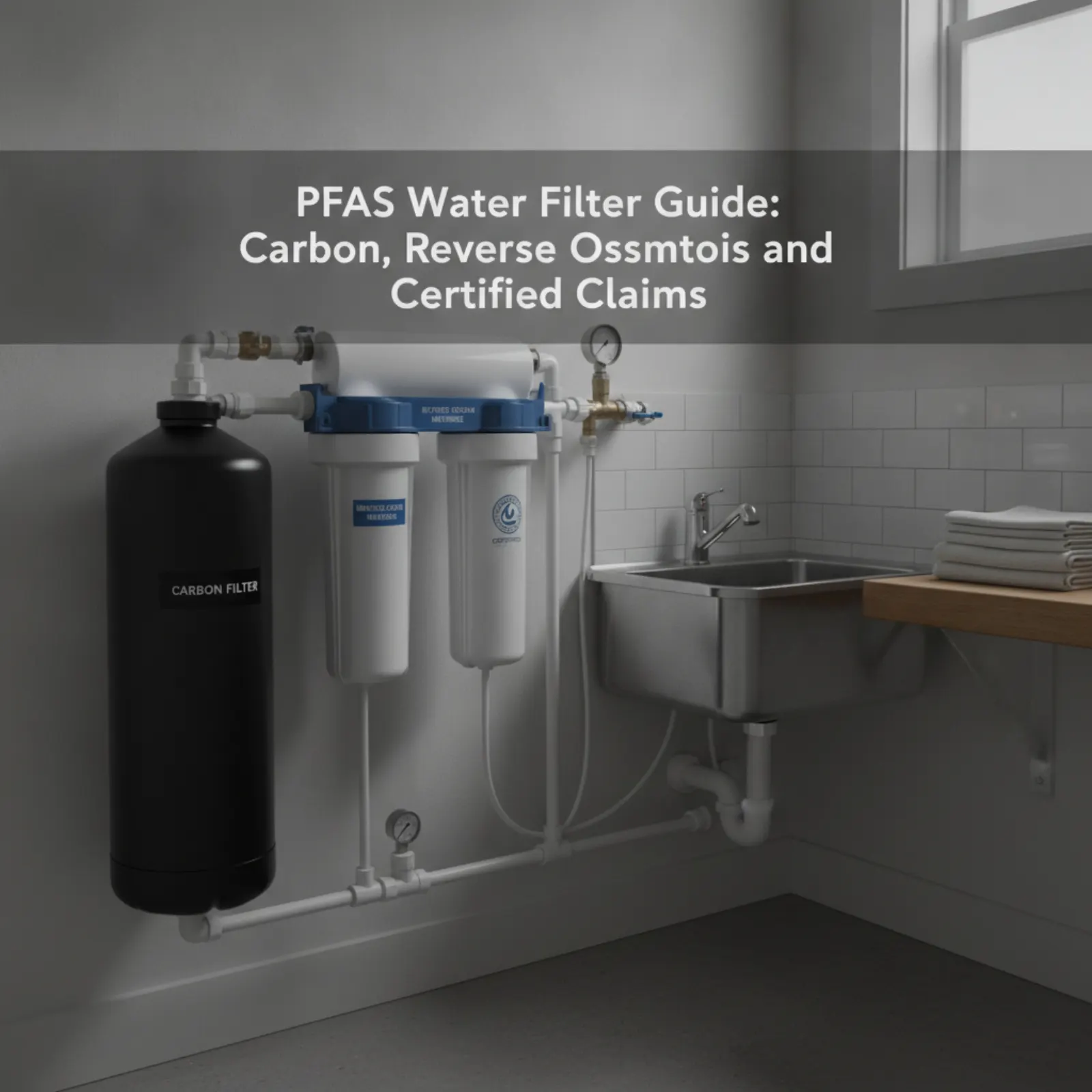
PFAS Water Filter Guide: Carbon, Reverse Osmosis and Certified Claims

Water Filter Guide

By Water Filter Guide Editorial Team

PFAS Water Filter Guide: Carbon, Reverse Osmosis and Certified Claims

How to choose a PFAS water filter, including activated carbon, reverse osmosis, NSF/ANSI 53 and 58 claims, exact model certification, and replacement costs.

Contaminants

Quick answer: For PFAS, compare exact model certifications and performance data. Activated carbon and reverse osmosis can both be relevant, but the filter must be tested or certified for the PFAS claim you care about.

Best for

Households whose water report, utility notice, or lab test raises PFAS concerns.

Wrong fit

People needing medical advice or emergency bottled-water guidance from local authorities.

Tradeoff

PFAS filtering is a certification and maintenance problem, not a broad purity promise.

PFAS is where water-filter marketing gets vague fast.

Stay with exact claims.

Quick Answer

Choose a filter with PFAS reduction claims supported by certification or performance data for the exact model. Activated carbon and reverse osmosis can both be valid lanes. Replacement schedule and flow rate matter because exhausted media will not keep performing like a new cartridge.

PFAS filter lanes

Filter laneBest fitWatch for
Certified pitcherLow-cost point-of-use startSmall capacity and slow flow
Under-sink carbonBetter daily flow and capacityModel-specific PFAS claim
Reverse osmosisBroad drinking-water treatmentWastewater, space, maintenance
Whole-house carbonWhole-home exposure reductionHigh cost and media monitoring

Certification matters

Do not accept "reduces PFAS" as a brand slogan. Look for the exact model in NSF, WQA, IAPMO, or manufacturer performance data, then check which PFAS compounds were tested and under what conditions.

A claim for one model does not cover the whole brand.

Start with the water report

If you are on public water, read the utility report and any PFAS notices. If you are on a private well near a known source or local concern, testing may be necessary.

The right filter depends on what is actually in the water.

Maintenance decides long-term value

PFAS filter ownership is replacement discipline. A system with expensive cartridges may still be worth it if it has better capacity and daily flow. A cheaper pitcher can become annoying if it clogs quickly or needs constant replacement.

Compare annual cost, not just first purchase price.

Frequently Asked Questions

Does reverse osmosis remove PFAS?

Many RO systems have PFAS reduction performance, but check the exact model claim and certification.

Is activated carbon enough for PFAS?

It can be for some products and conditions. Again, exact model testing matters.

Should I use a whole-house PFAS filter?

Usually start with drinking and cooking water unless whole-home exposure, local guidance, or specific test results justify the larger system.

How often should I replace PFAS filters?

Follow the rated capacity or time limit for the exact model. Do not stretch cartridges on health-related claims.

Sources

Methodology

These guides are built from manufacturer documentation, public specifications, primary research where health claims matter, and repeated buyer questions that show up in real ownership and installation decisions.

Manufacturer responses can clarify pricing bands, warranty terms, support footprint, or common mistakes. They do not move a page up the shortlist on their own.

Written by Water Filter Guide Editorial TeamReviewed by Water Filter Guide Editorial Team, Editorial review on July 6, 2026How we reviewEditorial policy

Next Step

What to do next

Use one of these three paths. They are here to move the decision forward, not add more noise.

Want the full buyer path in your inbox? We send the short version.

Related Guides

under-sink • installation

Under-Sink Water Filter Guide: Carbon, RO, Space and Replacement Costs

How to choose an under-sink water filter, including carbon vs reverse osmosis, cabinet space, faucet holes, flow rate, certifications, and replacement filters.

nitrate • private well

Nitrate Water Filter Guide: Why Private Wells Need Testing First

How to approach nitrate in drinking water, including private well testing, reverse osmosis, distillation, ion exchange, infants, and why carbon filters are not the default answer.

lead • certification

Water Filter for Lead: Certified Claims, Old Plumbing and What to Check

How to choose a water filter for lead reduction, including NSF/ANSI 53 claims, exact model certification, plumbing risk, flushing, and when to test water.

brands • roundup

Best Water Filter Brands 2026: Independent Shortlist by Filter Type

The best water filter brands to compare in 2026, organized by pitcher, under-sink carbon, reverse osmosis, and whole-house systems with pros, cons, and buyer fit.

pitcher • PFAS

Best Water Filter Pitcher for PFAS and Lead: What to Check First

How to choose a pitcher or dispenser for PFAS and lead reduction, including certification claims, flow, cartridge cost, and brands like Clearly Filtered, ZeroWater, Brita and LifeStraw.

reverse osmosis • carbon filter

Reverse Osmosis vs Carbon Filter: Which One Do You Actually Need?

A plain-English comparison of reverse osmosis and carbon filters for lead, PFAS, chlorine taste, nitrate, arsenic, fluoride, TDS, cost, maintenance and installation.