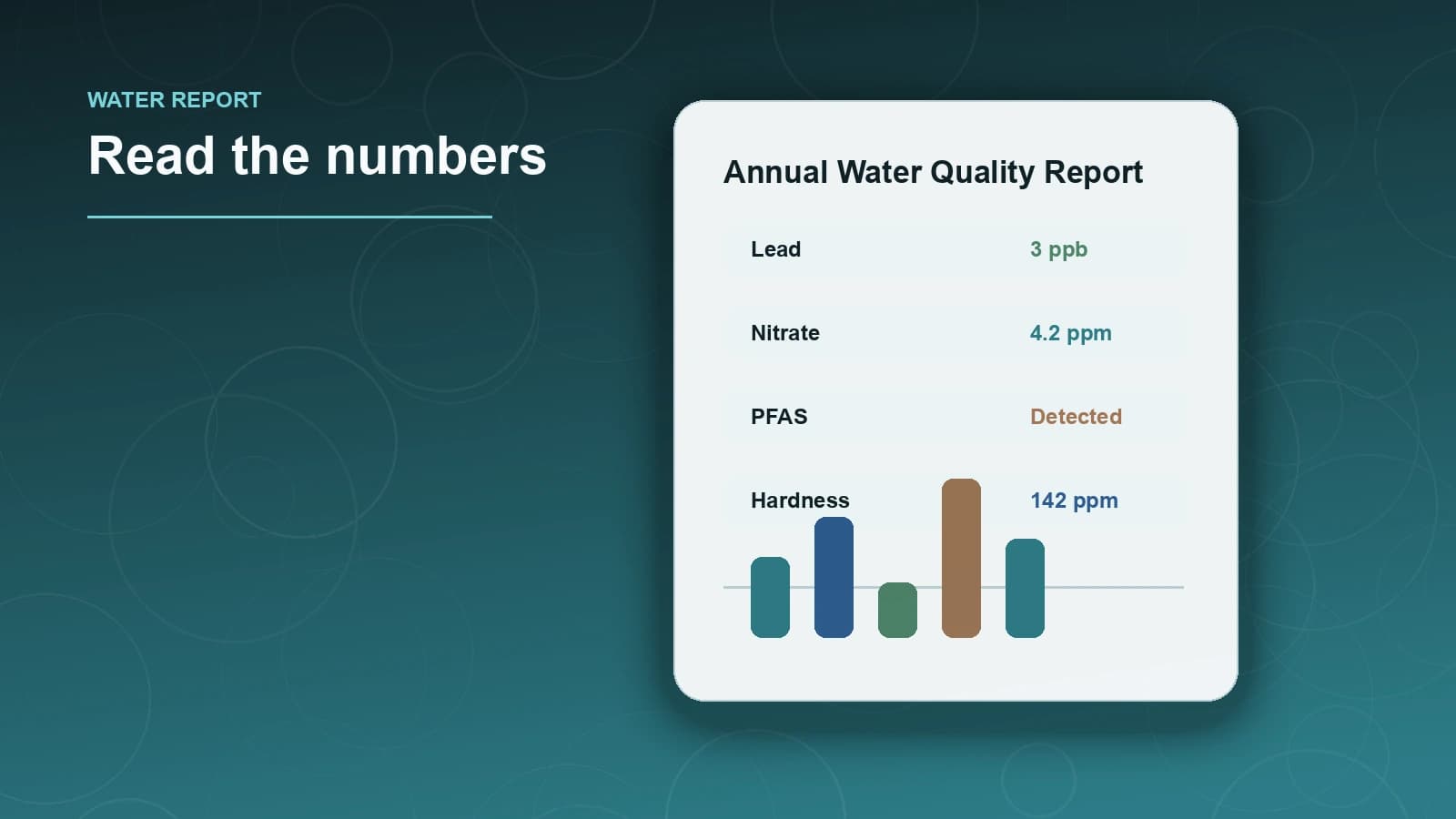
How to Read Your Water Quality Report Before Buying a Filter
A practical guide to Consumer Confidence Reports, private well tests, contaminant limits, and the numbers that change which water filter you should buy.
Water Report
Quick answer: Use the report to identify the contaminant first. Chlorine taste points toward carbon; nitrate, arsenic, fluoride, and high TDS usually push you toward reverse osmosis; bacteria or private-well concerns require testing and a treatment plan.
Best for
City-water customers reading a Consumer Confidence Report and private-well owners deciding whether to test.
Wrong fit
Anyone under a boil-water notice who needs official emergency guidance now.
Tradeoff
Utility reports are useful but not the same as testing the water at your tap.
The report comes before the product
Most filter mistakes happen because the buyer starts with a product page instead of a water problem. A water quality report gives you a starting map: what was detected, how much was detected, and whether the number is regulated, aesthetic, or simply worth watching.
For public water systems in the United States, the annual Consumer Confidence Report is the first document to read. For a private well, you need a lab test because there is no utility report covering the water at your tap.
Step 1: Identify whether you have city water or a private well
City water usually has a public report. It can show regulated contaminants, disinfectant residuals, detected byproducts, source-water notes, and compliance status. It does not guarantee that the last few feet of plumbing inside your building are clean.
Private wells are different. The owner is responsible for testing. If the concern is bacteria, nitrate, arsenic, lead, or PFAS, do not guess from taste.
Step 2: Separate health-related contaminants from aesthetic issues
Taste and odor matter, but they are not the same as health-related contaminants.
What you see
What it usually means
Filter direction
Chlorine taste or odor
Disinfection residual or byproduct taste
Carbon filter
Lead
Plumbing, service line, solder, brass, fixtures
NSF/ANSI 53 lead claim or RO
PFAS
Industrial or firefighting contamination, source-water issue
Certified PFAS reduction claim
Nitrate
Fertilizer, septic, agricultural runoff
Reverse osmosis or certified treatment
Arsenic
Geology, well water, regional source issue
RO or specialized treatment
Fluoride
Added or naturally occurring
RO if reduction is desired
Hardness
Calcium and magnesium
Softener, not a normal drinking-water carbon filter
Bacteria
Well integrity, intrusion, local event
Lab testing and disinfection plan
Step 3: Look at the unit
The number is not useful without the unit. You may see mg/L, µg/L, ppb, ppm, pCi/L, or colony counts. Do not compare two numbers until you know whether the unit matches.
As a rough conversion, 1 mg/L is usually equivalent to 1 ppm in water, and 1 µg/L is usually equivalent to 1 ppb. That does not mean the risk is the same across contaminants.
Step 4: Do not confuse "detected" with "unsafe"
A detected contaminant can be below the legal limit. It can also be legal and still worth reducing for taste, plumbing, or personal preference. The report helps you decide what problem to solve; it does not automatically tell you which product to buy.
If a number is above a regulatory limit, stop treating the purchase like a normal consumer comparison. Confirm the result, follow local guidance, and choose a certified treatment path.
Step 5: Check whether the problem is at the plant or at your tap
Lead is the classic example. A utility may treat water correctly, but a lead service line or old interior plumbing can still create a tap-level problem. If lead is your concern, use a first-draw test or a certified local lab, then choose a filter with a lead claim for the exact model.
Step 6: Translate the report into a filter lane
Use the report to narrow the technology:
Taste, odor, chlorine, some VOCs: carbon.
Lead and many health-related organic compounds: certified carbon block or RO.
Nitrate, arsenic, fluoride, high TDS: reverse osmosis is often the better lane.
Sediment: sediment pre-filter.
Hardness: softener or scale-control system.
Bacteria and boil-water concerns: test, disinfect, and follow local health guidance.
What to do next
If the report shows a specific contaminant, read the certification guide before comparing brands. If the report is confusing or missing tap-level issues, test the water. The best product page cannot fix a bad starting assumption.
Frequently Asked Questions
Is a Consumer Confidence Report enough to choose a filter?
It is enough to start, but not always enough to finish. A CCR describes the public water system, not every pipe and fixture between the plant and your glass.
Should private well owners use the same report?
No. Private well owners need lab testing because there is no utility report covering that water. Bacteria, nitrate, arsenic, and lead are common starting points.
Does bad taste mean unsafe water?
Not automatically. Chlorine taste, sulfur odor, and mineral taste can be aesthetic issues. Still, taste alone cannot rule out health-related contaminants.
What if the report shows PFAS?
Look for filters with a model-level PFAS reduction claim and verify the listing or performance data. Do not assume every carbon filter reduces PFAS.
These guides are built from manufacturer documentation, public specifications, primary research where health claims matter, and repeated buyer questions that show up in real ownership and installation decisions.
Manufacturer responses can clarify pricing bands, warranty terms, support footprint, or common mistakes. They do not move a page up the shortlist on their own.