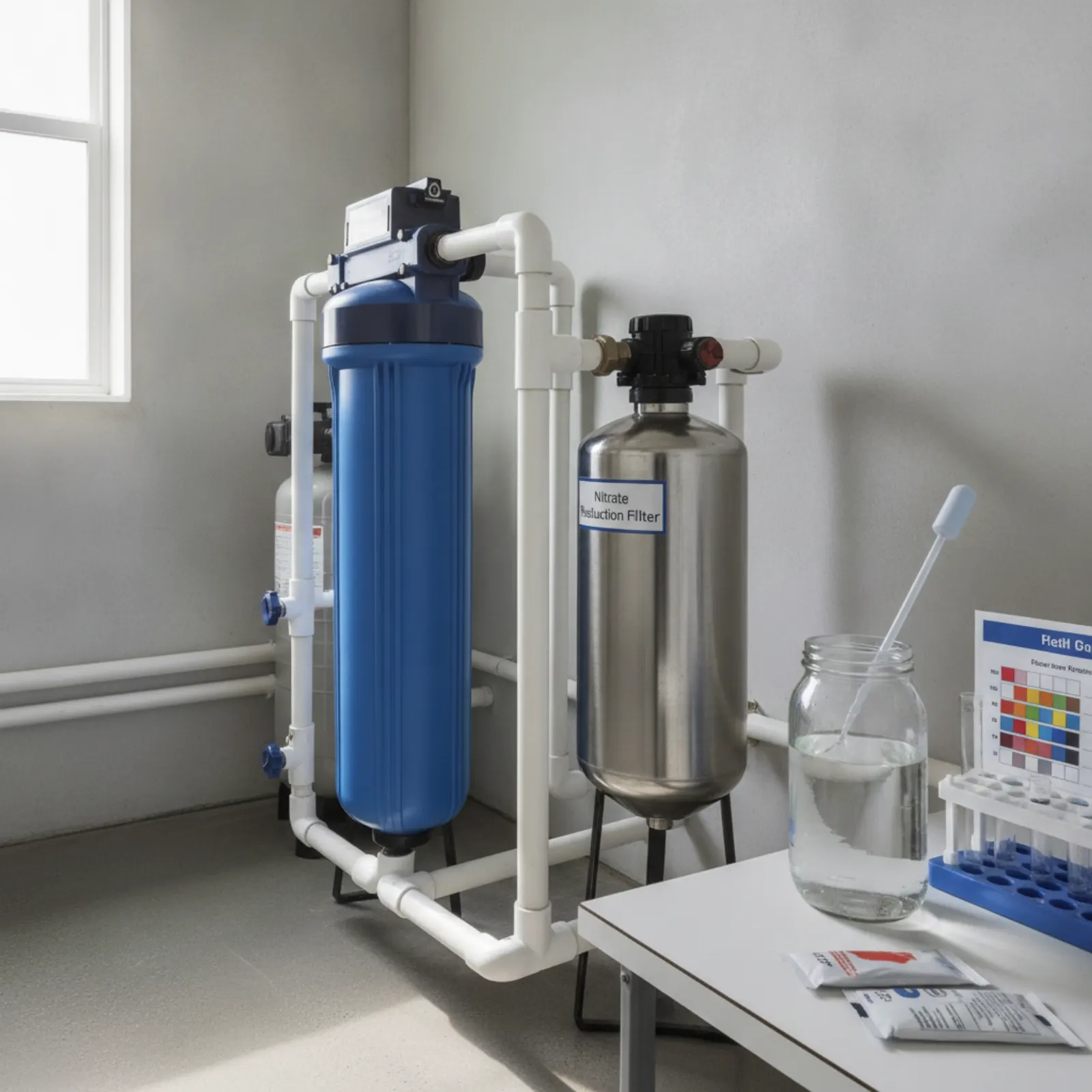
Nitrate Water Filter Guide: Why Private Wells Need Testing First

Water Filter Guide

By Water Filter Guide Editorial Team

Nitrate Water Filter Guide: Why Private Wells Need Testing First

How to approach nitrate in drinking water, including private well testing, reverse osmosis, distillation, ion exchange, infants, and why carbon filters are not the default answer.

Contaminants

Quick answer: For nitrate, test first and choose treatment based on the result. Reverse osmosis, distillation, or ion exchange may be relevant. Standard carbon taste filters are not the default nitrate solution.

Best for

Private well owners and households with nitrate concerns in a water test.

Wrong fit

Households with infants and a high nitrate result needing immediate local health guidance.

Tradeoff

Nitrate is a lab-result problem, not a taste problem. The water can look and taste normal.

Nitrate is one of the clearest examples of why taste is not a water test.

You can have a serious nitrate result in water that looks normal.

Quick Answer

If nitrate is a concern, test the water. For drinking and cooking water, treatment options may include reverse osmosis, distillation, or ion exchange systems designed for nitrate. Do not assume a standard carbon filter handles it.

Nitrate checklist

StepWhy it matters
Test with a certified labConfirms the level
Identify source riskAgriculture, septic, fertilizer, runoff
Check infant guidanceNitrate is especially important for infants
Choose treatment by claimNot all filters reduce nitrate
Retest after treatmentConfirms performance
Maintain cartridges or resinTreatment can fail when exhausted

Private wells are the priority

Public water systems are monitored under drinking-water rules. Private wells are the owner's responsibility. CDC notes that private wells are not regulated, treated, or monitored by officials the same way public systems are.

If you live near agriculture, septic systems, or known nitrate issues, testing is the starting point.

Carbon is usually the wrong default

Carbon filters can be excellent for taste, chlorine, some VOCs, and model-specific contaminant claims. Nitrate is a different problem. Look for treatment that specifically lists nitrate reduction and verify the exact model.

A filter that improves taste may leave nitrate unchanged.

Do not wait on high results

If nitrate is high, especially where infants, pregnancy, or vulnerable people are involved, follow local health department guidance. Bottled water may be a temporary bridge while treatment and retesting are handled.

This is not a place for trial-and-error shopping.

Frequently Asked Questions

Can a pitcher filter remove nitrate?

Most standard pitcher filters are not the default nitrate solution. Check exact model certification or performance data.

Is reverse osmosis good for nitrate?

Many RO systems are used for nitrate reduction, but verify the exact model claim and maintain it correctly.

How do I know if my well has nitrate?

Test it with a certified lab or local health department guidance. Taste and appearance are not reliable.

Should I treat the whole house for nitrate?

Usually drinking and cooking water are the first priority. Whole-house treatment may be considered when tests and local guidance support it.

Sources

Methodology

These guides are built from manufacturer documentation, public specifications, primary research where health claims matter, and repeated buyer questions that show up in real ownership and installation decisions.

Manufacturer responses can clarify pricing bands, warranty terms, support footprint, or common mistakes. They do not move a page up the shortlist on their own.

Written by Water Filter Guide Editorial TeamReviewed by Water Filter Guide Editorial Team, Editorial review on July 6, 2026How we reviewEditorial policy

Next Step

What to do next

Use one of these three paths. They are here to move the decision forward, not add more noise.

Want the full buyer path in your inbox? We send the short version.

Related Guides

private well • testing

Private Well Water Filter Guide: Test First, Then Choose the System

How private well owners should choose water filters after testing for bacteria, nitrate, arsenic, lead, hardness, iron, manganese, PFAS, and local contaminants.

PFAS • reverse osmosis

PFAS Water Filter Guide: Carbon, Reverse Osmosis and Certified Claims

How to choose a PFAS water filter, including activated carbon, reverse osmosis, NSF/ANSI 53 and 58 claims, exact model certification, and replacement costs.

water report • testing

How to Read Your Water Quality Report Before Buying a Filter

A practical guide to Consumer Confidence Reports, private well tests, contaminant limits, aesthetic issues, and the numbers that actually change which water filter you should buy.

brands • roundup

Best Water Filter Brands 2026: Independent Shortlist by Filter Type

The best water filter brands to compare in 2026, organized by pitcher, under-sink carbon, reverse osmosis, and whole-house systems with pros, cons, and buyer fit.

pitcher • PFAS

Best Water Filter Pitcher for PFAS and Lead: What to Check First

How to choose a pitcher or dispenser for PFAS and lead reduction, including certification claims, flow, cartridge cost, and brands like Clearly Filtered, ZeroWater, Brita and LifeStraw.

reverse osmosis • carbon filter

Reverse Osmosis vs Carbon Filter: Which One Do You Actually Need?

A plain-English comparison of reverse osmosis and carbon filters for lead, PFAS, chlorine taste, nitrate, arsenic, fluoride, TDS, cost, maintenance and installation.