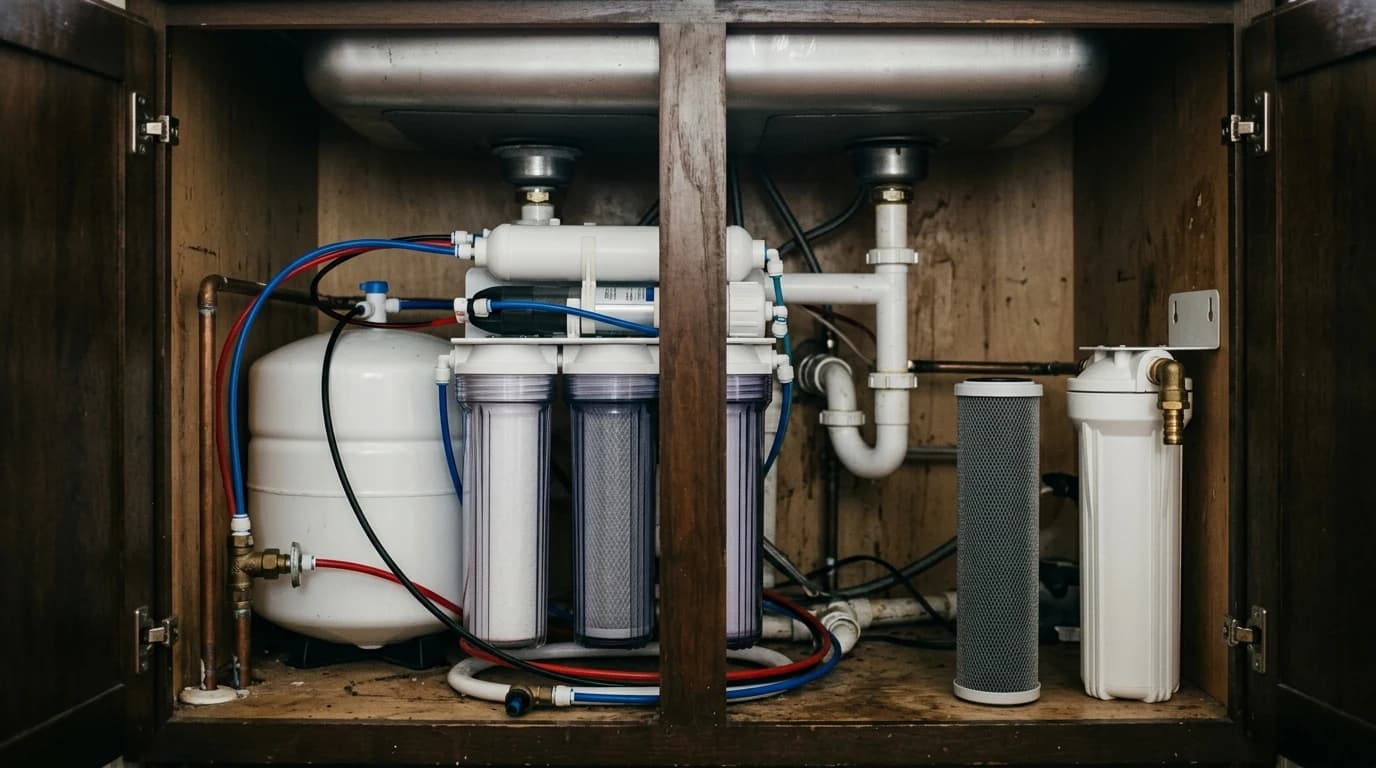
Reverse Osmosis vs Carbon Filter: Which One Do You Actually Need?
A plain-English comparison of reverse osmosis and carbon filters for lead, PFAS, chlorine taste, nitrate, arsenic, fluoride, TDS, cost, maintenance and installation.
Filter Type
Quick answer: Use carbon for taste, odor, chlorine, many VOCs, lead and PFAS when the exact model is certified. Use reverse osmosis when nitrate, arsenic, fluoride, high TDS, or broad dissolved solids are the reason you are filtering.
Best for
Buyers choosing between under-sink carbon, pitcher filters, countertop RO, tank RO, and tankless RO.
Wrong fit
Well owners with bacteria concerns who need testing and disinfection guidance first.
Tradeoff
RO usually covers more dissolved contaminants, but costs more, needs more space, can waste water, and may change taste.
The short answer
Carbon and reverse osmosis are not two versions of the same thing. They solve different problems.
Carbon is often the right move for chlorine taste, odor, many organic chemicals, some PFAS claims, and lead when the exact model is certified. Reverse osmosis is usually the stronger lane for nitrate, arsenic, fluoride, high TDS, and broad dissolved solids.
What carbon does well
Carbon filters work by adsorption. They are common in pitchers, faucet filters, countertop units, and under-sink systems. A good carbon block can be excellent for city-water taste and many health-related claims.
Carbon is usually best when:
The main complaint is chlorine taste or odor.
You want a no-waste, no-electricity option.
You need faster flow than a pitcher.
You want to keep minerals in the water.
The exact model is certified for your contaminant.
What carbon does not solve well
Carbon is not the default answer for nitrate, arsenic, fluoride, high TDS, or hardness. Some products may have specific claims, but the category as a whole should not be treated as universal.
If your water report shows one of those contaminants, compare reverse osmosis before buying a carbon-only system.
What reverse osmosis does well
Reverse osmosis forces water through a membrane and can reduce many dissolved contaminants that carbon does not handle well. Under-sink RO systems are common for drinking and cooking water.
RO is often the better lane when:
Nitrate appears in the water report.
Arsenic is a concern.
Fluoride reduction is a priority.
High TDS is the reason for filtering.
You want broad dissolved-solids reduction.
What reverse osmosis costs you
RO is not free in practical terms. It can be slower, more expensive, larger under the sink, and more maintenance-heavy. Tank systems take cabinet space. Tankless systems usually require electricity and proprietary filters. Many systems waste some water.
RO can also make water taste flat to some people, which is why remineralization stages exist.
Tank RO vs tankless RO
Classic tank RO is cheaper, familiar to plumbers, and easier to service. It takes more cabinet space and has slower refill behavior.
Tankless RO is cleaner under the sink, often faster at the faucet, and more modern. It usually costs more, needs power, and can lock you into proprietary cartridges.
Contaminant by contaminant: what each technology is certified for
"Carbon" and "reverse osmosis" are technology categories, not certifications. A specific model carries a specific claim, tested to a specific NSF/ANSI standard, and the two technologies are not certified for the same list. Our certifications guide covers how to read a listing; this table shows which technology is the recognized lane for each contaminant.
Contaminant
What carbon is certified for
What reverse osmosis is certified for
Governing standard
Is the claim model-specific?
Chlorine taste and odor
Removed well by standard carbon adsorption
Handled by the carbon pre-filter stage built into most RO systems, not by the membrane itself
NSF/ANSI 42
Yes, check the exact cartridge
Chloramine
Needs catalytic carbon and longer contact time; a separate claim from chlorine on the same listing
Same limitation: relies on the RO unit's carbon stage, not the membrane
NSF/ANSI 42, chloramine listed separately from chlorine
Yes
VOCs
A common carbon claim
Comes from the carbon stages in an RO system, not reliably from the membrane alone
Membrane pore size can physically exclude many microbes, but the system must be separately tested and certified as a microbiological purifier to carry that claim
NSF/ANSI P231, based on EPA's 1987 Guide Standard and Protocol for Testing Microbiological Water Purifiers
Rare on either technology. Most household RO and carbon systems sold for taste or TDS are not tested to this protocol
Sediment and turbidity
Reduced by a prefilter stage, rated in microns
Reduced by the sediment prefilter stage ahead of the membrane, rated in microns
NSF/ANSI 42, Particulate Reduction classes
Rated per stage, not one blanket number
Two rows trip people up more than the rest. First, arsenic: RO's NSF/ANSI 58 certification covers arsenic V specifically, and untreated well water often carries arsenic III, which passes through the same membrane far more easily. Second, bacteria: a fast RO membrane can physically block many microbes, but that is not the same as a tested disinfection certification, and most systems sold for taste or TDS were never tested against the microbiological purifier protocol. If bacteria is a live concern, especially on a private well, start with our private well water filter guide rather than assuming either technology handles it.
Maintenance and cost, with real models
Numbers beat adjectives. Here is one named model per lane, checked directly on the manufacturer's own product and replacement-filter pages on September 10, 2026.
Aquasana Claryum 3-Stage (carbon)
APEC ROES-50 (tank RO)
Waterdrop G3P600 (tankless RO)
Sediment prefilter interval
Bundled into the single 3-stage cartridge set
Stage 1, replaced with the annual filter set
CF filter, every 6 months
Carbon stage interval
Same set, every 6 months or 600 gallons
Stages 2, 3 and 5, replaced with the same annual filter set
CB filter, every 12 months
Membrane life
Not applicable
Stage 4 TFC membrane, APEC's own spec sheet says 2 to 4 years
RO membrane, every 24 months
Rated output
Not published for the standard 3-Stage (the Max Flow variant is rated 0.72 gpm)
50 GPD at 60 psi, 30 GPD at 50 psi and 77°F
600 GPD
Wastewater
None; no drain line
Recovery rate 25.4%, about 2.9 gallons to drain per gallon of product water
2:1 pure-to-drain, about 0.5 gallons to drain per gallon of product water
Electricity
None
None; runs on household line pressure (APEC recommends at least 40-45 psi)
Yes, needs a power adapter
Remineralization
Not applicable; carbon retains existing minerals rather than adding them
No, this model does not remineralize
No on the base model; a separate remineralization variant exists
System price
$349.99, or $279.99 with a Water for Life membership
$230.99
$626.97 list, frequently discounted
Annual consumable cost
About $168 a year (two $83.99 filter sets)
See note below
About $145 a year, per Waterdrop's own stated average
APEC's own product text is not internally consistent on the ROES-50's replacement schedule, and it is worth naming rather than smoothing over. APEC sells a "complete filter set" covering all five stages, including the membrane, for $79.99 and markets it as a set to replace together, even though the same product page states the membrane and stage-5 post-carbon filter last 2 to 4 years. A buyer who follows the longer interval can instead buy just the stage 1-3 prefilter set for $29.95 a year and the MEM-ES-50 membrane separately for $39.95 every 2 to 4 years, which puts realistic annual cost closer to $40-$45 rather than $80. Either schedule is defensible; APEC has just not picked one in its own marketing copy.
The wastewater numbers are the clearest reason tankless RO exists: the Waterdrop G3P600's pump-assisted 2:1 ratio sends roughly a sixth as much water to the drain, gallon for gallon, as the APEC ROES-50's tank-fed 25.4% recovery rate. That efficiency is why tankless systems need electricity and cost more up front. See the five-year ownership cost guide for how these numbers compound over a full system lifetime, and the replacement cost guide for per-consumable pricing across more models.
Certified PFAS claim; carbon or RO depending on model
Nitrate
RO
Arsenic
RO or specialized treatment
Fluoride
RO
High TDS
RO
Hardness
Softener or scale treatment
Bacteria
Testing and disinfection plan
Frequently Asked Questions
Is reverse osmosis always the best water filter?
No. RO is powerful, but it can be unnecessary for taste-only problems and less convenient for renters, small cabinets, or low-maintenance households.
Does carbon remove PFAS?
Some carbon filters have PFAS reduction claims. Verify the exact model and claim. Do not assume every carbon filter handles PFAS.
Does RO remove minerals?
RO reduces many dissolved solids, including minerals. Some people like the taste; others prefer remineralization.
Which is cheaper to own?
Carbon is usually cheaper and simpler. RO can be worth it when the contaminant profile calls for it.
Does reverse osmosis kill bacteria?
Not by default. A membrane's pore size can physically block many bacteria and viruses, but the system needs its own certification as a microbiological purifier under NSF/ANSI P231 to carry that claim. Most household RO units sold for taste or TDS reduction were never tested to that protocol. If bacteria is the concern, especially on a private well, start with our private well water filter guide rather than assuming an RO or carbon system handles it.
Can carbon or RO fix hard water?
Not economically. RO rejects some hardness minerals as part of general TDS reduction, but running a whole house through an RO system to solve scale wastes far more water than a dedicated softener, and carbon does not soften water at all. For hardness and scale, compare a softener certified under NSF/ANSI 44; see water filter vs water softener.
These guides are built from manufacturer documentation, public specifications, primary research where health claims matter, and repeated buyer questions that show up in real ownership and installation decisions.
Manufacturer responses can clarify pricing bands, warranty terms, support footprint, or common mistakes. They do not move a page up the shortlist on their own.