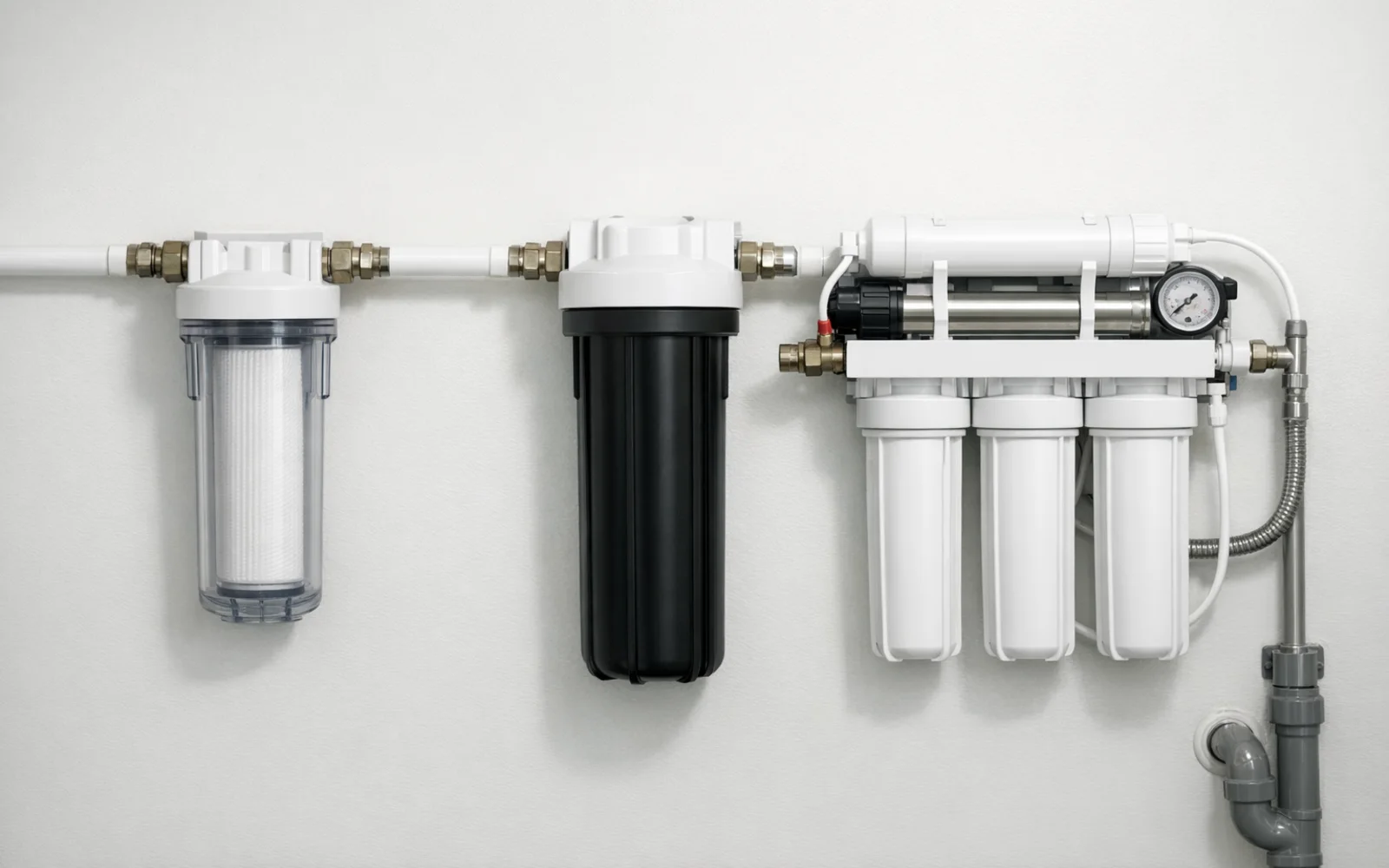
Water Filter Types: What Each One Removes (Micron & NSF)
A comparison of sediment, carbon, reverse osmosis, UV, and softener filters: what each removes, micron ratings, and the NSF/ANSI standard behind each claim.
Filter Type
Quick answer: No single filter removes everything. Sediment filters catch particles by micron size, carbon reduces chlorine and many chemicals, reverse osmosis handles dissolved solids like nitrate and arsenic, UV inactivates microbes, and softeners exchange hardness ions. Match the filter to your water report, then confirm the exact model carries the right NSF/ANSI certification.
Best for
Buyers trying to understand which filter technology matches a specific contaminant, and what micron and NSF numbers on a product page actually mean.
Wrong fit
Buyers who already know their filter type and only need a brand shortlist.
Tradeoff
Finer filtration and broader contaminant coverage usually cost more in price, flow, and maintenance, so the right type is the one matched to your water, not the one that removes the most.
The short answer
There is no filter that removes everything, and any product that implies otherwise is worth a second look. Each filter type solves a different problem.
Sediment filters remove particles by physical size.
Activated carbon reduces chlorine, taste, odor, and many chemicals through adsorption.
Reverse osmosis reduces dissolved contaminants that carbon leaves behind, such as nitrate, arsenic, and fluoride.
UV inactivates microorganisms but removes nothing physically.
Ion-exchange softeners swap hardness minerals, not health contaminants.
Whole-house systems treat water at the point of entry, usually for sediment and chlorine.
Start with your water report, decide what you actually need to reduce, then pick the type. The comparison below is the map.
Filter types, what they remove, micron rating, and NSF standard
Filter type
What it removes
Typical micron rating
Relevant NSF/ANSI standard
Sediment (spun or pleated)
Sand, silt, rust, dirt, and other suspended particles. Not chemicals or dissolved contaminants
1 to 50 micron (5 micron is common)
NSF/ANSI 42 (particulate reduction, aesthetic)
Activated carbon block
Chlorine, taste, odor, many VOCs, and lead, cysts, or PFAS when the exact model is certified
Dissolved solids such as nitrate, arsenic, fluoride, lead, PFAS, and high TDS
About 0.0001 micron (membrane pore)
NSF/ANSI 58 (reverse osmosis systems)
Ultraviolet (UV)
Inactivates bacteria, viruses, and protozoa. Does not remove particles or chemicals
Not a filter; needs pre-filtration to roughly 5 micron for clarity
NSF/ANSI 55 (UV, Class A or B)
Ion-exchange softener
Hardness minerals such as calcium and magnesium; some resins target specific ions
Not micron-rated (ion exchange, not straining)
NSF/ANSI 44 (cation exchange softeners)
Whole-house (point of entry)
Depends on the cartridge; commonly sediment plus chlorine taste and odor for the whole home
Varies by stage (5 to 50 micron sediment, plus carbon)
NSF/ANSI 42 and 53, depending on the cartridge
What a micron rating actually tells you
A micron rating describes the size of particle a filter is designed to catch. One micron is one-thousandth of a millimeter. A 5-micron sediment filter blocks particles roughly 5 microns and larger; a 0.5-micron carbon block catches finer material and some cysts.
Two things trip buyers up:
Nominal vs absolute. A nominal rating (the common one) means the filter removes most particles at that size, not all. An absolute rating is stricter and more consistent. If the difference matters for your use, look for which one the spec sheet states.
Smaller is not automatically better. A very fine filter clogs faster and slows flow. Sediment pre-filters are often intentionally coarser to protect the finer stages behind them.
Micron ratings only describe physical straining. They say nothing about dissolved contaminants like nitrate or about killing microbes, which is where carbon, RO, and UV come in.
Certification is the credibility check
A micron number and a contaminant list are marketing until an independent body verifies them. That is what NSF/ANSI certification is for. It ties a specific model to a specific claim tested to a published standard.
The standards you will see most often:
NSF/ANSI 42, aesthetic effects like chlorine taste, odor, and particulates.
NSF/ANSI 53, health-related claims like lead, cysts, VOCs, and some PFAS.
NSF/ANSI 58, reverse osmosis systems.
NSF/ANSI 401, emerging contaminants such as certain pharmaceuticals and chemicals.
NSF/ANSI 55, ultraviolet treatment (Class A for disinfection, Class B for supplemental).
NSF/ANSI 44, cation exchange water softeners.
The important move is to match the exact model number to the exact contaminant you care about, then confirm the standard behind it. For a deeper walkthrough, see the certifications guide.
How to pick your type
Read your water report and list the contaminants that matter. The water report guide helps.
If the problem is taste, odor, or chlorine, start with carbon.
It depends on the goal. For sediment protection, 5 micron is a common default. For finer reduction such as cysts, a carbon block near 0.5 to 1 micron is typical. There is no single correct number; match it to the contaminant and the stage.
Does a smaller micron rating mean a better filter?
Not by itself. A finer filter can catch more particles but also clogs faster and can reduce flow and pressure. The right rating balances the particle size you need to remove against flow and filter life.
Which filter type removes the most contaminants?
Reverse osmosis reduces the broadest range of dissolved contaminants, but it costs more, can waste water, and is not needed for taste-only problems. The most effective type is the one matched to your specific water, verified by NSF/ANSI certification.
Does UV remove chemicals or lead?
No. UV inactivates microorganisms but does not remove chemicals, lead, or particles. It is usually paired with sediment pre-filtration and, where needed, carbon or RO for chemical reduction.
These guides are built from manufacturer documentation, public specifications, primary research where health claims matter, and repeated buyer questions that show up in real ownership and installation decisions.
Manufacturer responses can clarify pricing bands, warranty terms, support footprint, or common mistakes. They do not move a page up the shortlist on their own.