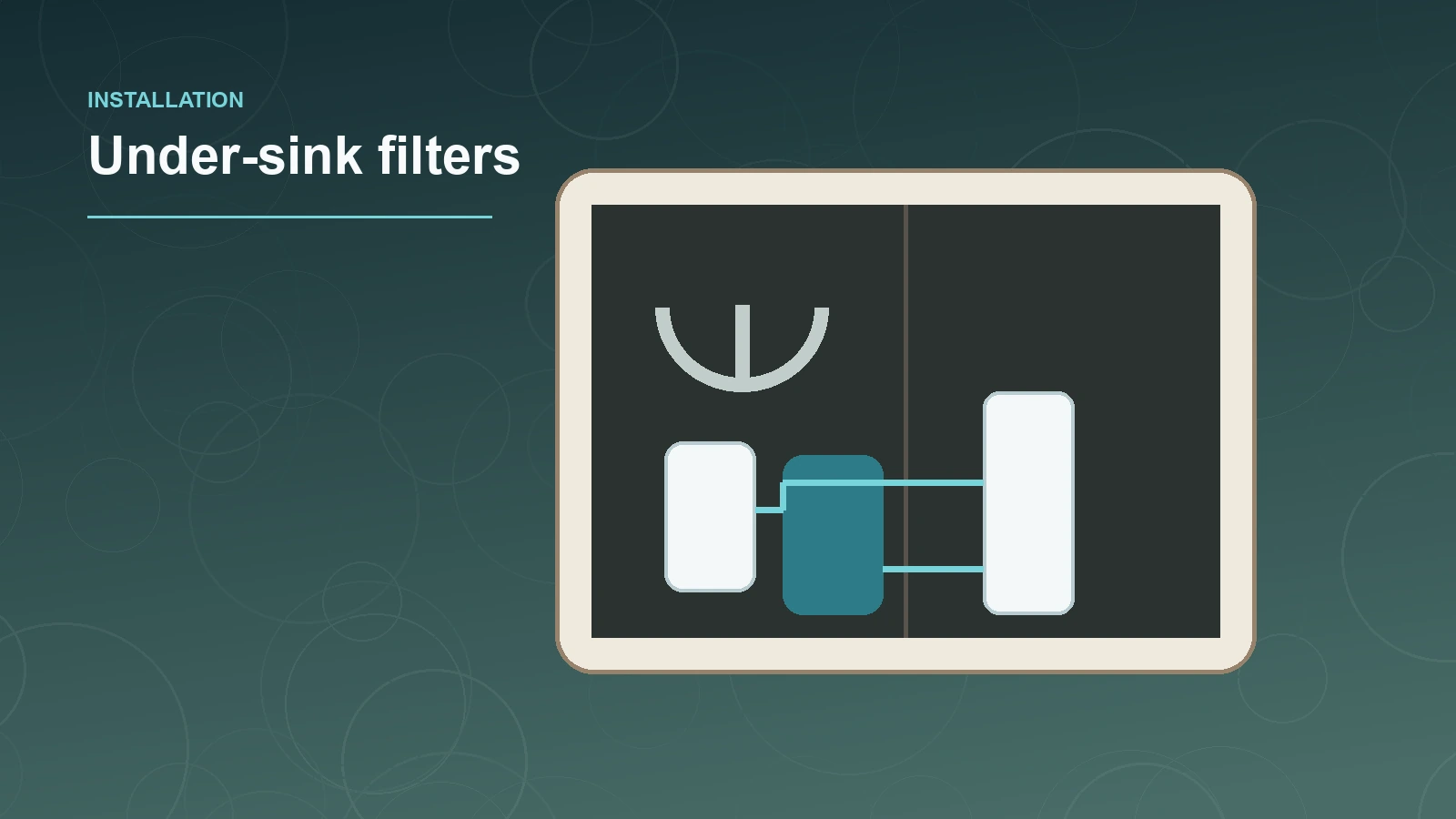
Under-Sink Water Filter Guide: Carbon, RO, Space and Replacement Costs

Water Filter Guide

By Anna Persson

Under-Sink Water Filter Guide: Carbon, RO, Space and Replacement Costs

How to choose an under-sink water filter, including carbon vs reverse osmosis, cabinet space, faucet holes, flow rate, certifications, and replacement filters.

Install & Maintenance

Quick answer: Choose under-sink carbon for certified city-water taste, lead, PFAS or VOC claims with simpler ownership. Choose under-sink RO when nitrate, arsenic, fluoride, high TDS or broad dissolved solids matter.

Best for

Homeowners and renters with install permission who want better flow and lower counter clutter than a pitcher.

Wrong fit

People with no cabinet space, no install rights, or microbial concerns that need testing first.

Tradeoff

Under-sink filters are cleaner day to day, but bad cabinet access can make maintenance easy to ignore.

Why under-sink is the serious middle lane

Under-sink systems sit between a pitcher and a whole-house project. They keep the counter clear, usually improve flow, and can handle stronger certified claims than many entry-level filters.

But under-sink is not one category. A compact carbon system and a tankless RO system are very different purchases.

Start with the filter type

If your water report points to chlorine taste, odor, lead, many VOCs, PFAS, or microplastics, an under-sink carbon system may be enough when the exact model is certified.

If your report points to nitrate, arsenic, fluoride, high TDS, or broad dissolved-solids concerns, compare reverse osmosis.

Measure before you fall in love with the product

Check:

  • Cabinet width, height, and depth.
  • Garbage disposal placement.
  • Existing plumbing and shutoff access.
  • Whether you can drill or use an existing faucet hole.
  • Electrical outlet availability for tankless RO.
  • Clearance to remove cartridges.

The filter that looks perfect online can be miserable to maintain if the cartridge cannot come out cleanly.

Carbon under-sink pros and cons

Pros:

  • No wastewater.
  • Usually no electricity.
  • Faster flow than many pitchers.
  • Often simpler replacement.
  • Can keep minerals in the water.

Cons:

  • Not the default choice for nitrate, arsenic, fluoride, or high TDS.
  • Certification scope varies heavily by model.
  • Replacement filters can be expensive.

Reverse-osmosis under-sink pros and cons

Pros:

  • Stronger lane for many dissolved contaminants.
  • Useful for nitrate, arsenic, fluoride, TDS and broad RO claims.
  • Can be very effective for drinking and cooking water.

Cons:

  • Larger footprint.
  • Possible wastewater.
  • More stages to maintain.
  • Tankless systems may need electricity.
  • Taste may require remineralization.

Brands to compare

For carbon: Aquasana, Hydroviv, Multipure.

For RO: Waterdrop, APEC, iSpring, Brondell.

Replacement cost is part of the purchase price

The first-year cost is not the sticker price. Add:

  • System price.
  • Faucet or adapter parts.
  • Plumber cost if needed.
  • Replacement filters for the first year.
  • Membrane replacement if RO.
  • Leak detector if cabinet risk matters.

If two systems are close in price, the cheaper replacement path often wins.

Frequently Asked Questions

Is under-sink better than a pitcher?

Usually for flow, daily convenience, and capacity. A pitcher can still be better for renters, low budgets, and no-install situations.

Do I need a plumber?

Some systems are DIY-friendly. A plumber is sensible when you are uncomfortable with shutoffs, drilling, RO drain connections, or leak risk.

Is tankless RO worth it?

It is worth comparing when cabinet space, flow, and modern controls matter. It is less attractive when power access and cartridge cost are concerns.

Can one under-sink filter solve the whole house?

No. It treats the dedicated tap. If shower, laundry, sediment, or appliance protection matters, compare whole-house systems separately.

Sources

Methodology

These guides are built from manufacturer documentation, public specifications, primary research where health claims matter, and repeated buyer questions that show up in real ownership and installation decisions.

Manufacturer responses can clarify pricing bands, warranty terms, support footprint, or common mistakes. They do not move a page up the shortlist on their own.

Next Step

What to do next

Use one of these three paths. They are here to move the decision forward, not add more noise.

Want the full buyer path in your inbox? We send the short version.

Related Guides