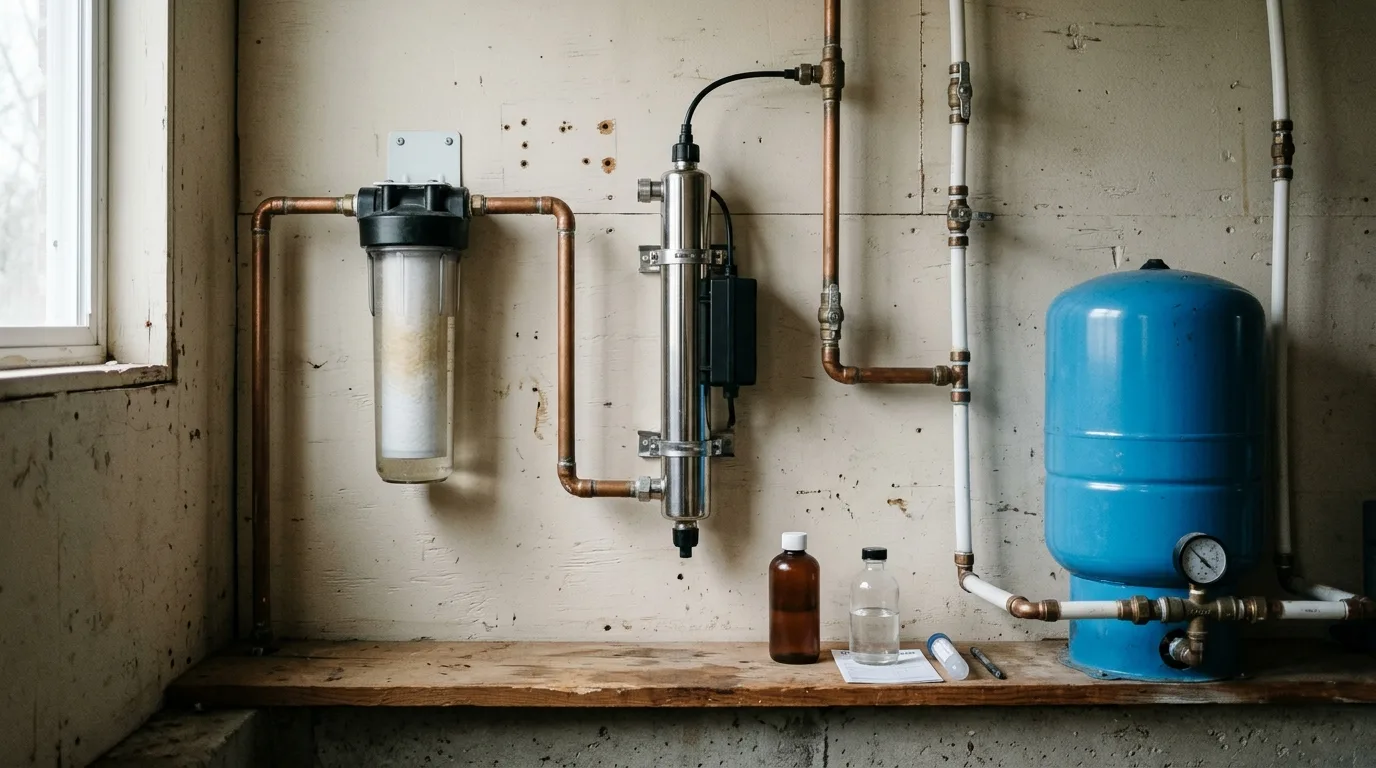
Bacteria in Well Water: Shock Chlorination, UV and Retesting
A positive coliform or E. coli result on a private well: what to do first, how agencies differ on shock chlorination, and when UV is the right fix.
Contaminants
Quick answer: Stop drinking the well water and use bottled or boiled water until a lab confirms a clean sample. A one-time positive is usually handled by finding the entry point, then shock chlorination, then retesting. Penn State Extension reports that shock chlorination plus a sanitary well cap kept bacteria out for a year in only 15 percent of wells in its study, so treat it as a reset, not a fix. If bacteria return, university guidance points to continuous disinfection, and for a private well that means an NSF/ANSI 55 Class A UV system on clear water, not a filter, pitcher or Class B unit.
Best for
Private well owners holding a positive total coliform or E. coli lab result, or planning for a well that tests positive again and again.
Wrong fit
Households on municipal water, or anyone who also has a nitrate, arsenic or lead result. Handle those first through the private well guide, because UV and chlorine do nothing for them.
Tradeoff
Shock chlorination is cheap but temporary and leaves the source untouched. UV protects continuously but only works on clear water, needs power and lamp changes, and cannot rescue a well with a structural leak.
A lab report that says coliform bacteria were detected is the one well-water result where you should stop and act before you shop. This guide covers the order of operations: protect the household, find the entry point, reset the system, retest, and only then decide whether you need continuous treatment.
Quick Answer
Do not drink the water, and do not treat a positive result as a filter-shopping problem. CDC's well guidance says to avoid drinking water from a well that may be contaminated with germs and use bottled water or another safe source until the well is treated and tested. For a first, isolated positive, university extension programs recommend shock chlorination after you check well construction, followed by retesting. If bacteria come back, extension guidance says shock chlorination is the wrong tool and continuous disinfection is needed. For a private well, the certified piece of equipment that matches that job is an NSF/ANSI 55 Class A UV system, installed after sediment filtration. Pitchers, under-sink carbon filters and Class B UV units are not substitutes. Your local health department decides what counts as safe for your area.
First 24 hours: what to do with a positive result
Switch water sources. Use bottled water, or water you have boiled. Ontario's provincial guidance allows a rapid rolling boil for at least one minute for an E. coli result. Check what your own health department says, because boiling advice varies.
Call the local health department. They know which labs are certified and whether your result is total coliform only or E. coli. E. coli is the more serious signal because it points to fecal contamination.
Resample before you chlorinate when E. coli is present. A second sample confirms the result and gives the contractor a baseline.
Look for the obvious entry point. Damaged or missing cap, cracked casing, a recent pump repair, flooding, or a septic field or animal pen close by.
Do not buy a filter yet. A carbon cartridge can grow bacteria on its surface, and nothing sold as a standard drinking-water filter is a health-effects disinfection claim.
Total coliform alone is common in the environment and is not itself a health threat. It is an indicator that the barrier between the well and the surface may be failing, which is why labs and agencies treat any detection seriously. The private-well test-first guide lists how often to test and which result stops the filter decision.
Shock chlorination: what agencies actually say
Shock chlorination means filling the well and plumbing with strongly chlorinated water, letting it sit, then flushing. Every source below agrees on the purpose. They differ on the numbers, so read the one your state publishes before you start.
Question
Penn State Extension
UNL Extension (G1761)
Ontario (Canada)
When to use it
New well, work on the well or pump, positive coliform test
Non-recurring coliform or E. coli, after repairs, flooding or runoff
E. coli detected
Contact time
Not stated on the page
At least 2 to 3 hours, overnight preferred
At least 12 hours without using the well
First retest
10 to 14 days after
1 to 2 weeks after
Resample until E. coli is absent in two consecutive sets taken 24 to 48 hours apart
Later retests
Again in 2 to 3 months
Monthly for 2 to 3 months, then annual
As the medical officer of health directs
If bacteria return
A continuous disinfection system is needed
Use continuous chlorination or another method, such as UV
Not covered on the page
As of October 22, 2026. The Ontario column is Canadian public-health practice and is shown to illustrate how contact times differ, not as a US rule. Maine's CDC page, as summarized in search results, recommends at least 12 hours and prefers 24. We could not open that PDF directly, so verify it before relying on it. The spread, from 2 to 3 hours to 12 hours or more, is the reason to follow your state or county procedure rather than a generic one.
The part most guides skip: how often it works
Penn State Extension reports that in its study, shock chlorination plus a sanitary well cap kept wells bacteria-free for one year in 15 percent of wells. It worked best in wells with fewer than 10 colonies per 100 mL and no E. coli. The same page calls shock chlorination "difficult and rarely successful" for springs, because water moves through the spring box too quickly for adequate chlorine contact. That is one extension study, not a national rate, but it is a useful reason to plan for the possibility that you will be back here in a few months.
Practical cautions from the UNL procedure
The UNL procedure targets 200 mg/L free chlorine and measures it with a kit that reads free chlorine, not total chlorine.
It calls for fresh, unscented household bleach (5 to 6 percent sodium hypochlorite), because bleach weakens with age, light and heat.
It says to drain the water heater, to bypass bladder-type pressure tanks if the manufacturer advises it, and to remove activated carbon and reverse osmosis filters before dosing. Penn State adds that high chlorine can damage or exhaust treatment equipment.
It limits discharge into a septic system to 50 gallons of chlorinated water. Penn State warns against sending high-chlorine water to streams, ponds or wetlands.
It warns that chlorine is hazardous in confined spaces and recommends goggles, gloves and boots.
The University of Arizona publication cautions that household bleach can react with well components and groundwater chemistry in unpredictable ways, and points readers to a licensed well professional.
This guide does not give a dose table. The amount depends on well diameter, water depth and system volume, and a wrong dose either fails to disinfect or damages equipment. Use your state's procedure or a licensed well contractor.
When shock chlorination is the wrong fix
Situation
Why a reset will not hold
What to do instead
Positive again on the retest
Penn State and UNL both say recurring bacteria need continuous disinfection
Move to the UV decision below
Casing damage, loose cap or leaking pitless adapter
Surface water still reaches the well
Repair first; UNL says shock chlorination does not replace fixing well construction
Spring or shallow dug well
Contact time is too short in a spring box
Ask the health department or a licensed contractor
High colony count or E. coli
Penn State found best results at fewer than 10 colonies per 100 mL and no E. coli
Expect to need a repair and continuous disinfection
UV for a private well: what the certification means
UV treatment inactivates microorganisms with ultraviolet light. It does not remove anything from the water, so it does nothing for nitrate, arsenic, lead, PFAS, chlorine taste or hardness. Our filter types guide shows where it fits next to sediment, carbon and RO.
The label that matters is NSF/ANSI 55, which has two classes:
Class
Intended water
What the standard says it is for
Class A
Well or surface water that may be microbiologically contaminated
Designed to inactivate microorganisms, including bacteria, viruses, Cryptosporidium and Giardia. Requires a UV sensor and alarm. Not intended for raw sewage or to convert wastewater to drinking water.
Class B
Water already deemed acceptable for drinking
Supplemental treatment of nuisance organisms only. Should not make microbiological health-effects claims.
Source: WCP Online trade article on NSF/ANSI 55, which also says Class A water must be visually clear for the optimal UV dose. An Ohio county health fact sheet, seen as a search excerpt only, quotes the Class A dose as at least 40 mJ/cm² at 254 nm at the alarm set point, and notes that cheaper units can deliver as little as 16 mJ/cm². Verify the dose on the exact model's NSF listing instead of trusting a spec sheet.
The practical consequence is simple. A UV unit with no Class A listing is not a primary disinfection answer for a well that tested positive, even if its marketing mentions bacteria. Check the listing using the steps in our certifications guide.
What UV needs to work
Clear water. Connecticut's health department, as quoted in search results, does not recommend UV for water with substantial color or suspended solids, or with high total coliform or confirmed E. coli. We could not open the Connecticut PDF directly, so treat this as a pointer to your own health department's rules.
Iron, manganese and hardness handled first. They stain and scale the sleeve. See the water softener comparison and the iron guide above.
Power and flow. A UV lamp needs electricity and does not store protection. Size the unit to your peak household flow.
Lamp changes and retesting. Lamp life is set by the manufacturer. Our replacement cost guide shows a priced example of a residential lamp. After installation, sample the treated water to confirm it works, and keep testing at least annually. Many labs and health departments will also tell you how often to retest in your state.
A decision rule
Your result
Next step
Total coliform only, first detection
Check the well for entry points, shock chlorinate per your state procedure, retest in 1 to 2 weeks
E. coli detected
Do not drink. Call the health department, resample, inspect the well, then disinfect and retest
Clean retest, then positive again within months
Plan continuous disinfection: a Class A UV system after sediment filtration, plus a repair if a structural cause is found
Positive after flooding
EPA says not to drink or wash with flooded well water; have a contractor clean and disinfect the well before turning the pump back on
Positive plus nitrate above 10 mg/L
UV and chlorine do not remove nitrate; use the nitrate guide and talk to your health department about infants in the home
When you are ready to compare equipment, use the brand hub to check which companies sell NSF/ANSI 55 Class A units, then confirm the exact model in the NSF listing. For whole-house cost context, see the five-year cost guide and the treatment quote checklist, which covers electrical work for UV.
What this guide could not verify
Dose-by-well-size tables. We deliberately left these to your state or a licensed contractor.
A single national retest schedule. Sources differ and agencies publish their own.
Direct text of the Maine, Connecticut and Ohio PDFs. They did not open as readable text in this run, so claims drawn from them are labeled as search excerpts.
Current prices for NSF/ANSI 55 Class A models. Not checked, so none are given.
Frequently Asked Questions
Is total coliform in well water dangerous?
Total coliform is common in the environment and is not itself a health threat. It is an indicator that surface contamination may be reaching the well. E. coli is more concerning because it is linked to fecal contamination. Until a lab confirms a clean sample, follow your health department's advice about drinking water.
How long after shock chlorination should I retest?
Penn State says 10 to 14 days, UNL says 1 to 2 weeks, and both recommend a repeat test after a few months. Ontario's procedure uses two consecutive negative sample sets 24 to 48 hours apart. Use your state or county lab's instructions, and make sure the chlorine has cleared so the lab does not reject the sample.
Can a carbon filter or pitcher fix bacteria in well water?
No. Standard carbon and pitcher claims are not a substitute for disinfection of microbiologically unsafe water. Use disinfection matched to the result, and see the private well guide.
Does UV kill bacteria in all well water?
Only in clear water with an adequate dose. NSF/ANSI 55 Class A is the certification for well and surface water. Cloudy water, a fouled sleeve or a weak lamp reduces protection, and UV does not remove chemicals.
Do I still need to test annually with UV installed?
Yes. EPA advises testing a private well yearly for total coliform, nitrates, total dissolved solids and pH, and testing sooner after flooding, repairs or a change in taste, color or odor.
These guides are built from manufacturer documentation, public specifications, primary research where health claims matter, and repeated buyer questions that show up in real ownership and installation decisions.
Manufacturer responses can clarify pricing bands, warranty terms, support footprint, or common mistakes. They do not move a page up the shortlist on their own.