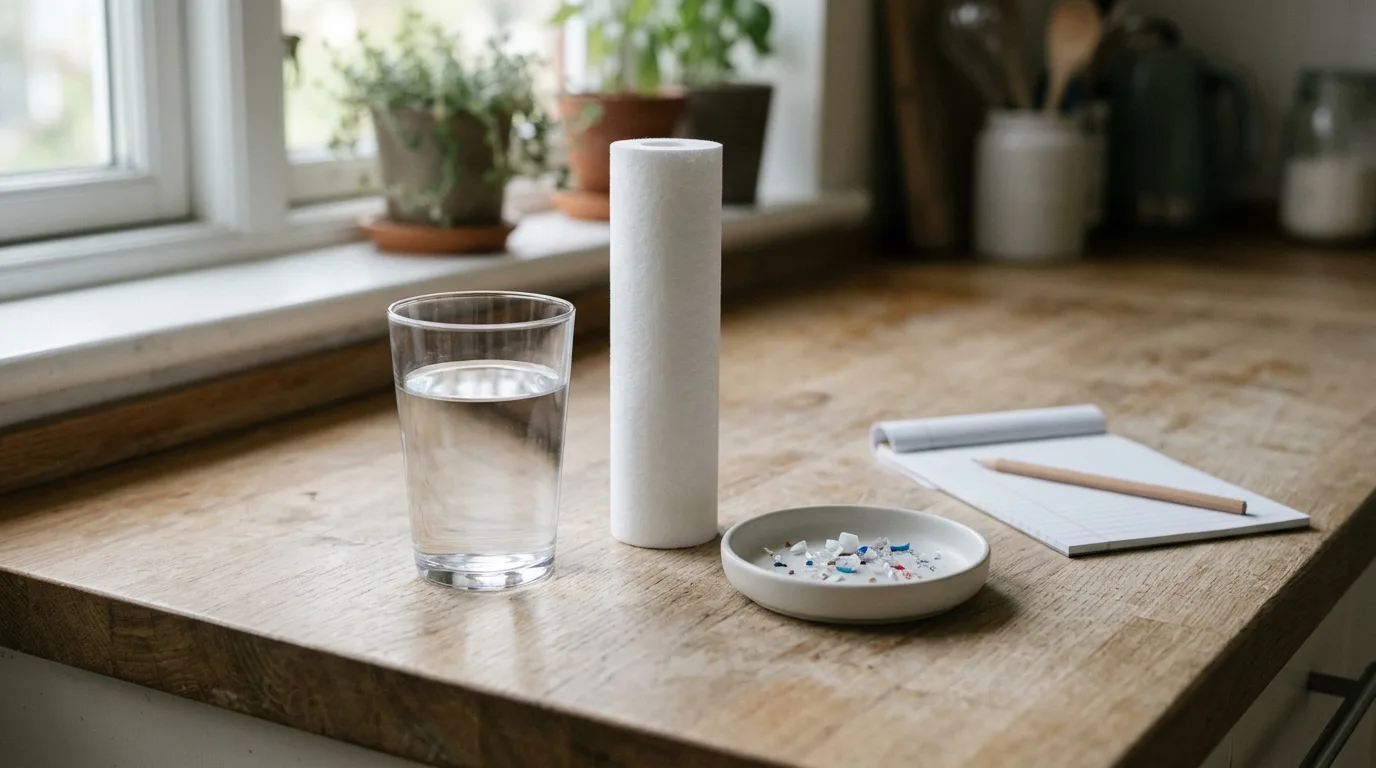
Do Water Filters Remove Microplastics? What NSF/ANSI 401 Lists
Which filters carry a listed microplastics reduction claim, what the claim does and does not cover, and what WHO says about health risk. NSF listings read November 12, 2026.
Contaminants
Quick answer: Some do, but only a model with a Microplastics Reduction line in its NSF/ANSI 401 listing has independent certification behind the claim. As of November 12, 2026, that line appears on specific Multipure, PUR, Brita Total360, Whirlpool, Samsung and Everpure models, and on none of the Waterdrop rows we read. It can sit on one filter cartridge and not on another cartridge for the same pitcher. WHO says microplastics in drinking water do not appear to pose a health risk at current levels, so this is a precaution, not a safety fix.
Best for
Buyers who saw a 'removes microplastics' claim on a pitcher, faucet filter, under-sink system or refrigerator filter and want to know whether an independent listing backs it.
Wrong fit
Anyone with a lead, PFAS, nitrate, arsenic or bacteria concern. Microplastics are not the contaminant to start with, and a microplastics listing says nothing about those.
Tradeoff
A listed microplastics claim is real but narrow: it is one line on one model and cartridge combination, and the evidence that microplastics in tap water harm health is limited. Paying extra for it makes sense only if you want the precaution.
Microplastics marketing is loud and the certification is quiet. This guide reads the certifier's own listing so you can tell which claims have independent backing.
Quick Answer
The listing to check: NSF/ANSI 401, titled by NSF "Drinking Water Treatment Units: Emerging Compounds / Incidental Contaminants." Microplastics appear there as a claim named "Microplastics Reduction," listed per model and per replacement element.
Who has it (NSF listing, current as of November 12, 2026): specific models from Multipure, PUR, Brita (Total360 plumbed-in), Whirlpool, Samsung, Everpure, 3M and others. Many listed rows are commercial, ice-machine and refrigerator filters, not household pitchers.
Who we did not find there: no text match for Aquasana, ZeroWater, Berkey, LifeStraw, AquaTru, Hydroviv, APEC, iSpring, Culligan or Clearly Filtered. None of the Waterdrop rows we read carries the claim. Absence from this one standard is not proof a filter fails to catch particles, and we did not check IAPMO or WQA databases.
Health context: WHO's 2019 assessment says microplastics in drinking water do not appear to pose a health risk at current levels, with more research needed. Treat a microplastics claim as precaution, not protection from a known hazard.
Start elsewhere if you can: lead, PFAS, nitrate and bacteria are the documented drinking-water risks. See the lead guide and PFAS guide first.
What the claim is, and what we could confirm
NSF/ANSI 401 is a multi-claim standard. Each listed model carries a set of separate lines, such as pharmaceuticals, bisphenol A, DEET and, for some models, microplastics. A filter can hold most of those lines and still not hold the microplastics line.
What we confirmed from NSF's own pages:
NSF's ballot records show a microplastics reduction claim was proposed for 401 in a July 2021 ballot, which also defined "microplastics" under NSF/ANSI 330. A later ballot, "401i33r1 - Microplastics," opened October 16, 2023 and described adding a test procedure for reverse osmosis systems to reduce microplastics. A further draft ballot closed January 29, 2024. NSF's public pages we read did not show vote outcomes.
The public listing page exists and uses the exact claim wording "Microplastics Reduction."
What we could not confirm: the exact test particle size and pass threshold. Several filter vendors and review sites say the claim covers particles of 0.5 to 1 micrometer at 85 percent reduction, and one describes the test as using the same dust test as NSF/ANSI 42 Class I particulate. Those are secondary and vendor statements, and we could not open NSF's standard text, so treat the numbers as unverified. A trade-press piece from May 27, 2024 describes the certified definition as plastic particles from 5 millimeters down to one micron. Either way, the certification is not a claim about nanoplastics.
Model-level listings we read (NSF, current as of November 12, 2026)
Rated capacity ("service cycle") and flow are as shown on the NSF listing. "Not listed" means not shown with the microplastics line in the rows we read.
Model
Type
Element
Rated capacity (gal)
Flow (gpm)
Microplastics line
Multipure Aquaversa
Plumbed-in
CB6
750
0.75
Listed
Multipure Aquaperform
Plumbed-in
CB11As
600
1
Listed
Multipure Aquapremier
Plumbed-in
CBXT
340
0.71
Listed
Multipure Aqualite
Plumbed-in
CB5
450
0.5
Listed
PUR FM-2000B
Faucet mount
RF-3375 / RF-9999
100
0.52
Listed
PUR PPT111B pitcher, with PPF951K / CRF-950Z element
Pitcher
PPF951K, CRF-950Z
40
not applicable
Listed
PUR PPT111B pitcher, with PPF900Z element
Pitcher
PPF900Z
40
not applicable
Not listed
Brita Total360 BRDPFS
Plumbed-in
BRDPFF9
2,000
1.8
Listed
Whirlpool WHARSS5
Plumbed-in
WHARSF5
750
0.5
Listed
Samsung DA97-08006C
Refrigerator filter
DA97-08006C
316
0.4
Listed
Waterdrop EFF-6002S
Plumbed-in, rows read
WDP-4396508, WDP-F02, WDP-F15
300
0.5
Not listed (other 401 lines only)
Two findings the vendor pages do not show:
The cartridge decides, not the pitcher. On NSF's listing, the same PUR PPT111B pitcher appears twice. The row paired with the PPF951K / CRF-950Z element lists microplastics. The row paired with PPF900Z lists other emerging-compound lines but not microplastics. Buy by the replacement element number.
Most listed rows are not what shoppers meet first. The page includes large numbers of commercial modular, ice-machine and refrigerator filters. Household pitchers appear only through specific elements, so a brand name alone settles nothing.
We did not record prices. Prices change and we did not check them this run, so use our replacement cost guide to budget the cartridge once you pick a model.
What does and does not follow from a microplastics line
If a listing shows...
It tells you
It does not tell you
Microplastics Reduction under NSF/ANSI 401, on your exact model and element
Independent lab testing supports that line for that combination
Lead, PFAS, nitrate or arsenic reduction. Those are separate standards (53, 58, 372)
A 401 listing without the microplastics line
The model is certified for other emerging-compound lines
Anything about microplastics
No 401 listing, with "microplastics" in the marketing
A manufacturer claim
Independent verification. Look for another certifier listing on the exact model
A fine-pore claim such as "0.5 micron"
The stated pore size
A tested reduction percentage
This is the same certified-versus-claimed split our certifications guide uses for every contaminant. For a one-minute method to check any model, see its "Verify a model in 60 seconds" section.
Which technologies plausibly help
Solid carbon block, certified model: the 401-listed rows we read are largely carbon block or similar fine filters. That is a description of the listing, not a general claim about all carbon.
Sediment cartridges: the particle rating on a sediment prefilter is a size claim. Without a tested reduction listing, we would not count it as a microplastics claim. A coarse 5-micron cartridge sits above the sizes the certification discusses.
Reverse osmosis: NSF's 2023 ballot described adding a microplastics test procedure for RO systems. We did not find, and did not search for, RO models carrying the line, so we make no RO claim here. For what RO and carbon do for other contaminants, read reverse osmosis vs carbon.
Boiling, settling and cloth filtering: we found no primary source testing these for microplastics, so we do not rank them.
What WHO says about risk
WHO's 2019 report "Microplastics in drinking-water" and the accompanying press release say that, based on limited information, microplastics in drinking water do not appear to pose a health risk at current levels. WHO says particles larger than 150 micrometres are not likely to be absorbed in the human body, and it calls for more research, including standard measurement methods. WHO recommends that suppliers and regulators prioritize removing microbial pathogens and chemicals that are known risks.
Our reading: buying a certified microplastics filter is a defensible precaution, especially when it also fits your other needs, but nothing we found shows that it improves health outcomes. We did not review newer epidemiology on microplastics in the body, and we would treat claims that a filter "protects your family from microplastics" as unverified.
A buyer decision rule
Your situation
What to do
You want a microplastics precaution and a pitcher or faucet filter
Search the exact replacement element number on NSF's 401 listing. Buy only the element that shows the line
You already own an under-sink or whole-house system
Look up your model on NSF. If it is not there, treat any microplastics claim as the maker's
NSF/ANSI 401 standard text, so the test particle size, challenge material and pass criterion are unverified.
Vote outcomes for the 2021, 2023 and 2024 NSF ballots.
IAPMO and WQA databases. A model may carry a microplastics or particulate claim from another certifier that we did not check.
Whether any reverse osmosis system carries the 401 microplastics line.
Prices and availability. We gave none.
How we read NSF's listing: we parsed the full page text of the 401 listing, current as of November 12, 2026, and spot-checked each model above against the page. NSF warns that web text can be manipulated and says to confirm any listing on its site, so verify before you buy.
Whether the same models appear under the same names in retail packaging.
Frequently Asked Questions
Do water filters remove microplastics?
Some do, and the only independent check we found is a "Microplastics Reduction" line in a model's NSF/ANSI 401 listing. Many filters make the claim without a listing. Check the exact model and replacement element.
Is there an NSF standard for microplastics in drinking water?
NSF added a microplastics reduction claim to NSF/ANSI 401, and the public listing uses the wording "Microplastics Reduction." We could not read the standard text, so we cannot state its test details.
Does a Brita pitcher remove microplastics?
On the NSF 401 listing we read on November 12, 2026, the Brita entries are the Total360 plumbed-in models, not Brita pitchers. We did not find a Brita pitcher with the line. Check Brita's current model against NSF before relying on a claim.
Does reverse osmosis remove microplastics?
NSF ballots in 2023 and 2024 describe adding a microplastics test procedure for reverse osmosis systems, but we did not verify any RO model carrying the claim. Check the model listing.
Are microplastics in tap water dangerous?
WHO's 2019 assessment says microplastics in drinking water do not appear to pose a health risk at current levels, based on limited information, and calls for more research.
Should I buy a microplastics filter before a lead or PFAS filter?
No. Lead, PFAS, nitrate and bacteria are the better-documented drinking-water risks. Start with your water quality report and add a microplastics claim only if it fits.
These guides are built from manufacturer documentation, public specifications, primary research where health claims matter, and repeated buyer questions that show up in real ownership and installation decisions.
Manufacturer responses can clarify pricing bands, warranty terms, support footprint, or common mistakes. They do not move a page up the shortlist on their own.